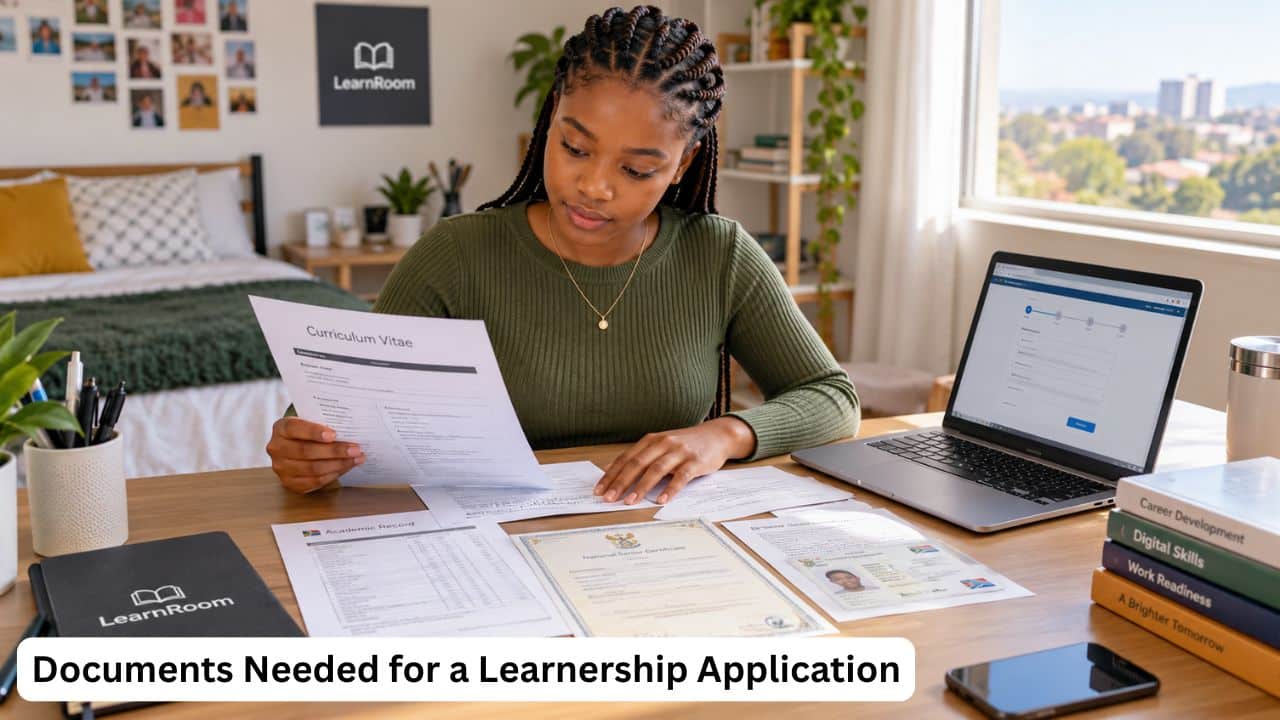
A missing certificate, unreadable identity document or outdated curriculum vitae can cause problems even when you qualify for a learnership. While every programme has its own requirements, applicants are commonly asked for documents such as a curriculum vitae, identity document, school results, qualifications and sometimes proof of residence.
The important thing is not to send every document you have.
Instead, read the programme instructions carefully and submit exactly what the organisation requests.
If you are still unsure whether you meet the education, age or location criteria, first read LearnRoom’s guide to common learnership requirements before preparing your documents.
Are the same documents required for every learnership?
No.
There is no universal document pack that every learnership applicant must submit.
One programme may ask only for a curriculum vitae and identity document during the first stage.
Another may require:
- Curriculum vitae
- Identity document
- Grade 12 certificate
- Academic record
- Qualification certificates
- Proof of residence
- Additional programme-specific documents
Some organisations collect certain documents only after applicants have been shortlisted.
This is why you should always use the requirements attached to the specific programme rather than copying the document list from another application.
1. Curriculum vitae
A curriculum vitae is one of the most commonly requested application documents.
It gives the organisation a summary of your education, skills and experience.
For an entry-level learnership, a curriculum vitae can include:
- Full name
- Contact number
- Email address
- Area of residence
- Education
- Qualifications
- Relevant subjects
- Skills
- Computer knowledge
- Languages
- Volunteer experience
- Relevant short courses
- Previous experience where applicable
Do not worry if you have never held formal employment.
Many learnerships are designed to help applicants gain workplace experience.
Your education, abilities and relevant activities can still provide useful information.
What should a learnership curriculum vitae look like?
Keep it simple and easy to read.
Avoid complicated designs that make important information difficult to find.
Your contact details should be accurate and visible.
Your education section should clearly show:
- Institution or school
- Qualification
- Year completed
- Relevant subjects where useful
If you have previous experience, include it accurately.
Do not invent work history simply because you think your curriculum vitae looks too short.
Should your identity number appear on your curriculum vitae?
You do not necessarily need to display your full identity number on the curriculum vitae unless the organisation specifically requires it.
Personal information should be shared carefully.
If the application portal separately asks for an identity number, provide it through the legitimate application process.
Avoid publishing highly sensitive information unnecessarily on documents that may be widely shared.
2. South African identity document
Many South African learnership programmes ask applicants to provide a copy of their identity document.
This may be used to verify details such as:
- Identity
- Age
- Citizenship where relevant
- Information entered in the application
Make sure the copy is readable.
The photograph, names and important details should not be cut off or blurred.
If the application asks for both sides of an identity card, make sure both sides are included.
Should your identity document be certified?
Only if the programme specifically asks for a certified copy.
Do not assume every learnership requires certification at the first application stage.
Some organisations accept ordinary copies initially and request certified documents later.
Others may require certification from the beginning.
Follow the exact instructions.
If certification is required, also check whether the organisation specifies how recent the certification must be.
3. Grade 12 certificate
A Grade 12 certificate is commonly requested when the programme requires applicants to have completed Grade 12.
This allows the organisation to confirm that you meet the minimum education requirement.
It may also be used to check specific subjects or results.
For example, a programme could require:
Grade 12 with Mathematics
or:
Grade 12 with Mathematics or Mathematical Literacy.
In that case, simply proving that you completed Grade 12 may not be enough.
Your results must also show that you meet the subject requirement.
What if you have not received your final certificate?
Some applicants may have completed school but do not yet have the final certificate available.
Depending on the programme, the organisation may accept an official statement of results or another recognised document.
Do not assume this will always be accepted.
Check the application instructions.
If the programme specifically requires a certificate and does not mention alternatives, use an official enquiry channel if one is provided.
4. School results
Some programmes ask for school results even when applicants have already completed Grade 12.
This may happen when the organisation needs to check:
- Mathematics results
- Mathematical Literacy results
- English results
- Physical Sciences
- Technical subjects
- Other programme-specific subjects
Upload the correct document.
Do not send a result sheet that is so dark, small or blurred that the recruiter cannot read the marks.
5. Qualification certificates
If the learnership requires a certificate, diploma, degree or another post-school qualification, you may need to provide proof.
Use the official qualification document issued by the relevant institution.
For example, if a programme requires an NQF Level 5 qualification, the organisation may need evidence that your qualification meets that requirement.
If NQF terminology is confusing, LearnRoom’s guide to NQF Levels 1 to 10 explains how the qualification framework works.
Do not guess your qualification level when completing an application.
Verify it if the level is important to your eligibility.
6. Academic record
An academic record is different from a qualification certificate.
The certificate usually confirms that you completed the qualification.
An academic record normally provides more detailed information about the subjects or modules you completed and your results.
Graduate or higher-level learnerships may request an academic record so that recruiters can assess your studies in more detail.
Make sure the academic record belongs to the qualification you have listed on your curriculum vitae.
7. Proof of residence
Some learnerships are restricted to applicants living in a particular:
- Province
- Municipality
- District
- Community
- Local area
In these cases, proof of residence may be requested.
The organisation may specify which documents it accepts.
Do not assume that every form of proof will be accepted.
Where the programme provides instructions, follow them exactly.
Also avoid sending proof of residence when it has not been requested, particularly if the document contains unnecessary personal information.
Why does residence matter?
Some programmes are designed to benefit people from a specific community.
Others require participants to report to a workplace or training centre every day.
This means location can be part of the eligibility process rather than simply a preference.
Before preparing proof of residence, make sure you actually meet the geographical requirement.
8. Driver’s licence
Most learnerships do not automatically require a driver’s licence.
However, programmes involving travel, field work, deliveries, technical operations or particular workplace responsibilities may require one.
If a licence is compulsory, the opportunity should normally state this.
Provide a copy only when requested.
Do not assume having a driver’s licence will improve every application.
9. Professional or technical certificates
Some specialised programmes may ask for additional certificates.
Examples could include:
- Computer training certificates
- Technical qualifications
- Industry-specific certificates
- Occupational training
- Safety training
- Other relevant credentials
Submit certificates that are specifically required or genuinely relevant.
Do not overwhelm the application with every certificate you have ever received.
The goal is to help recruiters verify your suitability, not to create an unnecessarily large document pack.
10. Proof of disability where specifically required
Some programmes are specifically designed to recruit persons with disabilities or may request particular supporting documentation.
Applicants should follow the exact instructions provided.
Do not assume what documentation is needed.
Medical and disability information is sensitive, so it should be supplied only through an appropriate and legitimate process when required.
11. Application form
Some organisations use their own application forms.
This can be:
- An online form
- A downloadable document
- A recruitment portal
- A programme-specific form
Complete every required section accurately.
Do not assume that uploading your curriculum vitae means you can leave the application form incomplete.
Recruitment systems may use information entered directly into the form during screening.
LearnRoom’s step-by-step guide to applying for learnerships explains the full process from checking eligibility to submitting and tracking your application.
Do government learnerships always require a Z83 form?
No.
A Z83 form is associated with applications for certain positions in the South African public service.
You should not automatically attach a Z83 form to every government-related learnership application.
Use one only when the official instructions specifically require it.
Attaching unnecessary documents does not improve an application.
Do all documents need to be certified?
No.
Certification requirements differ between organisations.
A programme may ask for:
Certified copies of qualifications and identity document
while another may initially request:
Copies of qualifications and identity document
These instructions are not identical.
If certification is required, follow the requirement.
If it is not mentioned, do not automatically reject an opportunity because your copies are not certified.
The organisation may request certified documents later in the recruitment process.
What does “certified copy” mean?
A certified copy is a copy of an original document that has been checked against the original by an authorised person.
The certification confirms that the copy corresponds with the original document presented.
If an organisation requires certified copies, make sure the certification is clear and complies with any instructions given in the application.
Do not attempt to create or alter certification yourself.
Should you submit original certificates?
Normally, applicants should be very cautious about handing over original certificates unless there is a legitimate reason and proper process for verification.
Applications generally involve copies or digital versions.
Original documents may later be requested for verification.
If you are asked to surrender an original qualification permanently, verify the request before doing so.
Your original certificates are important records.
What file format should you use?
The application portal may specify accepted formats.
Common formats can include:
- JPG
- PNG
- Microsoft Word documents
Where possible, PDF can be useful for documents because the layout remains consistent.
However, follow the actual portal requirements.
If the system only accepts particular formats, convert your files before starting the application.
How should you name your documents?
Use clear file names.
For example:
Thando-Mokoena-CV.pdf
Thando-Mokoena-ID.pdf
Thando-Mokoena-Grade-12.pdf
Thando-Mokoena-Academic-Record.pdf
This is much clearer than:
IMG00182.jpg
or:
scan-final-new-3.pdf
If the organisation gives its own file-naming instructions, use those instead.
Check that every document opens
Before uploading anything, open each file.
Check that:
- It is the correct document
- Every page is included
- Text is readable
- Nothing is cut off
- The file is not corrupted
- The orientation is correct
Do this before submitting.
Applicants sometimes upload the wrong file because several documents have similar names.
A simple check can prevent that mistake.
Do not upload password-protected documents unless requested
A password-protected document may prevent a recruiter or recruitment system from opening it.
Unless the organisation specifically asks for encrypted or protected files, submit documents that authorised reviewers can access normally.
Also check whether the application portal has a maximum file-size limit.
Large scanned documents may need to be compressed.
Should you combine documents into one PDF?
Only when the application instructions make this appropriate.
Some systems ask for separate uploads:
Curriculum vitae
Identity document
Qualification
Other application processes may ask applicants to combine several documents into one file.
Do not choose randomly.
Follow the structure provided by the application system.
Make sure names match across your documents
Your application form, curriculum vitae and supporting documents should accurately reflect your identity.
If there is a genuine difference in names across documents, there may be a legitimate explanation.
Do not alter official documents yourself.
If clarification is required, follow the organisation’s process for supporting documentation.
Consistency helps reduce confusion during verification.
What documents should you avoid sending unnecessarily?
Do not submit sensitive information simply because you think more documents will make your application stronger.
Unless specifically and legitimately required, be cautious about sending:
- Bank card details
- Banking passwords
- Personal identification numbers
- One-time passwords
- Full online banking login information
- Unrelated medical records
- Documents containing unnecessary financial information
A legitimate organisation may eventually require banking details for payments after selection, but it should never need your banking password or card personal identification number.
If payment information becomes relevant later, LearnRoom’s guide explaining how learnership stipends and allowances usually work covers what learners should check.
Should you send banking details with the initial application?
Only when a legitimate application process specifically requires them and you are confident that the request is genuine.
For many programmes, detailed banking information becomes relevant only after a learner has been selected and payment arrangements are being established.
Do not send financial information to random WhatsApp numbers or unofficial email accounts simply because someone claims it is required to secure your place.
Never send documents before checking the opportunity
Identity documents, qualifications and proof of residence contain valuable personal information.
Before sending them, check:
- The organisation offering the programme
- The application website
- The email address
- Whether the opportunity appears legitimate
- Whether the documents requested make sense for the application
A fake learnership can be used to collect personal information.
Do not allow an attractive stipend or urgent deadline to stop you from checking where your documents are going.
Can you use documents saved on your phone?
Yes, provided the files are clear, correctly formatted and accepted by the application system.
It can help to create a dedicated folder on your phone or computer containing your current documents.
For example:
Learnership Documents
Inside it, keep:
- Current curriculum vitae
- Identity document copy
- Grade 12 certificate
- Qualification certificates
- Academic record
- Other commonly required documents
This can make future applications faster.
However, always check that you are uploading the correct version.
Keep your curriculum vitae updated
Your curriculum vitae should not remain unchanged forever.
Update it when you:
- Complete a qualification
- Finish a short course
- Gain relevant experience
- Change your phone number
- Change your email address
- Develop useful new skills
Before every application, open it and check the contact details.
A recruiter cannot reach you if the phone number on your curriculum vitae no longer works.
Should you include a cover letter?
Only when requested or when the application process clearly provides an appropriate place for one.
Many learnership applications do not require a separate cover letter.
Do not create unnecessary documents simply because you think every application must resemble a traditional employment application.
Follow the programme instructions.
What if one of your documents is missing?
First check whether the document is actually compulsory.
If it is, try to obtain the correct document through the appropriate institution before the deadline.
Do not upload an unrelated file merely to bypass a required field.
If the organisation provides an official enquiry contact, you can ask whether an alternative document is accepted.
Do not assume.
What if you lose your Grade 12 certificate?
If a certificate has been lost, use the appropriate official process to obtain replacement records or confirmation.
Do not create your own certificate or alter another document.
If an application deadline is approaching, check whether the programme accepts an official alternative such as a recognised statement of results.
Again, this depends on the programme.
Can an application be rejected because of missing documents?
Yes.
If a programme clearly states that particular documents are compulsory and you fail to provide them, your application may be considered incomplete.
This is why applicants should review the requirements before submitting.
A useful final check is:
- Did I meet the eligibility requirements?
- Did I attach every compulsory document?
- Can every file be opened?
- Are all documents readable?
- Are my contact details correct?
- Did I use the required application method?
- Did I submit before the closing date?
Taking a few extra minutes can prevent an avoidable problem.
Create a reusable learnership document pack
If you plan to submit several applications, create a basic document pack in advance.
Keep current copies of commonly requested documents ready.
However, do not send the entire pack automatically.
For each application:
- Read the requirements.
- Select only the relevant documents.
- Check certification requirements.
- Check file formats.
- Confirm file names.
- Review every upload.
- Submit using the official method.
This gives you the convenience of being prepared without ignoring programme-specific instructions.
Final Thoughts
The documents needed for a learnership application vary from one programme to another, but a curriculum vitae, identity document and proof of your education or qualifications are among the most common.
Additional documents may include academic records, proof of residence, specialised certificates or programme-specific forms.
The key is not to send the largest possible document pack.
It is to send the correct documents, in the correct format, through the correct application channel.
Before uploading anything, confirm that you meet the learnership requirements and then follow LearnRoom’s step-by-step application guide to complete the rest of the process carefully.
Frequently Asked Questions
Applicants are commonly asked for a curriculum vitae, identity document and proof of education or qualifications. Some programmes may also request academic records, proof of residence or other supporting documents.
Only if the programme requires a certified copy. Certification requirements differ between organisations, so check the specific application instructions.
Some do and some do not. An organisation may accept ordinary copies during initial screening and request certified documents later. Follow the wording in the individual programme.
No. Some programmes require Grade 12, while others accept different education levels or require post-school qualifications.
That depends on the programme. Some online systems collect all required information directly, while many opportunities still request a curriculum vitae.
Only when the programme requests it or when residence is part of the eligibility requirements.
No. Use a Z83 form only when the official application instructions specifically require one.
Only if a legitimate official process specifically requires them. Never provide banking passwords, personal identification numbers or one-time passwords to someone claiming they are needed for a learnership application.
