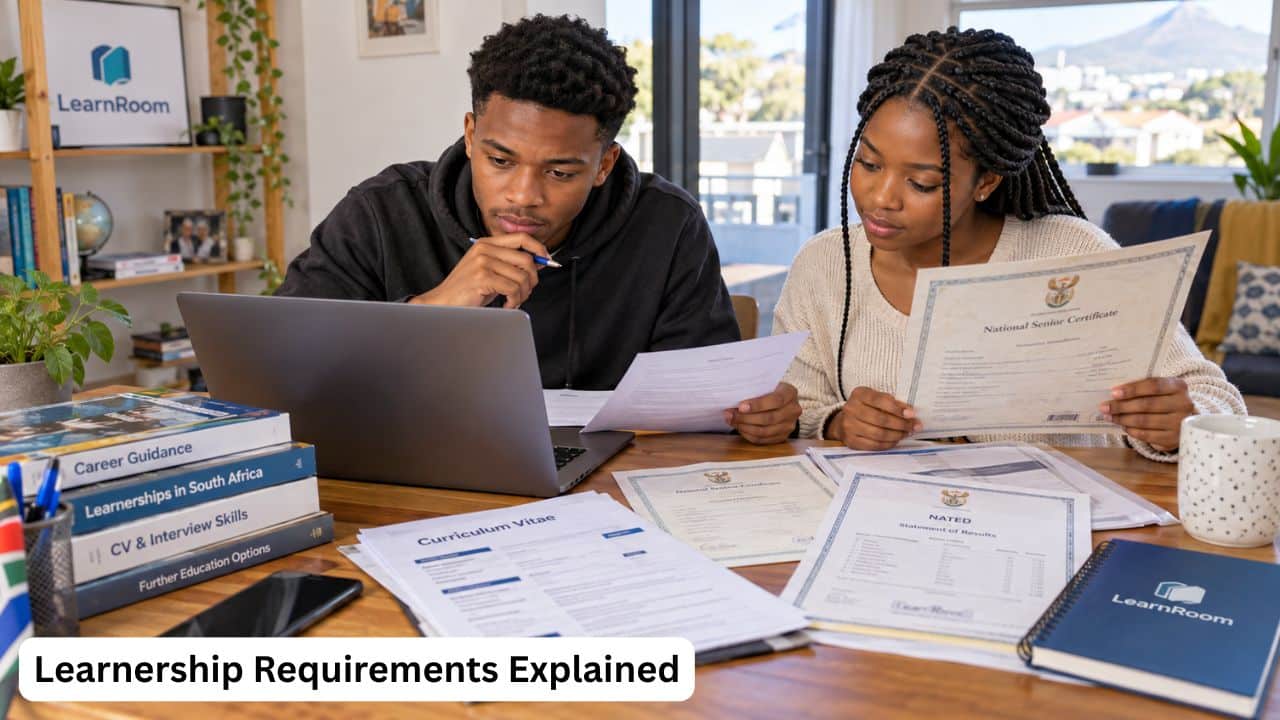
Learnership requirements can look confusing because there is no single set of rules that applies to every programme. Some opportunities accept applicants with Grade 10 or Grade 11, while others require Grade 12, particular school subjects, a specific qualification, an age range or residence in a certain area.
The most important thing for applicants to understand is that each learnership has its own eligibility criteria.
Meeting the requirements does not guarantee selection, but applying for programmes that genuinely match your qualifications can help you avoid wasting time on opportunities for which you are not eligible.
If you are completely new to these programmes, start with LearnRoom’s guide explaining what a learnership is and how it works before looking at the requirements in more detail.
Are learnership requirements the same everywhere?
No.
There is no universal checklist that every learnership applicant must meet.
Requirements can depend on the:
- Qualification being offered
- National Qualifications Framework level
- Industry
- Employer
- Training provider
- Funding arrangement
- Workplace location
- Target group of the programme
This is why two learnerships advertised at the same time can have completely different requirements.
One programme may accept applicants who completed Grade 10, while another may require Grade 12 with Mathematics.
A more advanced programme may require a diploma, certificate or another qualification before applicants can be considered.
Always treat the requirements listed in the specific opportunity as the ones that matter.
What education do you need for a learnership?
Educational requirements vary widely.
Depending on the programme, applicants may need:
- Grade 10
- Grade 11
- Grade 12
- A National Senior Certificate
- A National Qualifications Framework qualification
- A certificate
- A diploma
- A degree
- A qualification in a particular field
Some learnerships are designed for school leavers and therefore have relatively basic entry requirements.
Others are aimed at people who already have post-school qualifications and need workplace exposure or additional occupational training.
Do not assume that all learnerships are only for people with Grade 12.
At the same time, do not assume Grade 12 automatically makes you eligible for every programme.
Do you need Grade 12?
Not always.
Grade 12 is a common requirement, but many programmes use different entry levels.
Some may accept Grade 10 or Grade 11.
Others may require qualifications beyond Grade 12.
The exact education requirement should be stated in the programme information.
If an opportunity says:
Minimum requirement: Grade 12
then an applicant who has completed a diploma or degree will normally still have Grade 12 as part of their education history.
However, applicants should also check whether the programme has additional conditions that could affect eligibility.
Can you apply with Grade 10 or Grade 11?
Yes, if the specific programme allows it.
Some learnerships are created for applicants who have not completed Grade 12.
This can make them useful for people who left school earlier but still want to develop recognised skills and practical workplace experience.
The important thing is to look for programmes where the official entry requirements match your highest completed level of education.
Do not change or exaggerate your qualifications to appear eligible.
Do school subjects matter?
Sometimes.
A programme may require applicants to have passed particular subjects.
Common examples can include:
- Mathematics
- Mathematical Literacy
- English
- Physical Sciences
- Accounting
- Business Studies
- Computer-related subjects
- Technical subjects
The subjects required normally relate to the type and level of training involved.
For example, a technical programme may place greater importance on Mathematics or relevant technical subjects than a general administration programme.
If a subject is listed as compulsory and you did not pass it, you may not meet the programme’s minimum requirements.
Do your marks matter?
They can.
Some programmes simply require applicants to have passed a particular qualification.
Others may specify a minimum percentage for certain subjects or an overall academic result.
For example, a programme could require applicants to have achieved a particular result in Mathematics or English.
If minimum marks are listed, check your certificate or academic record before applying.
Do not assume that passing the subject is enough if the employer has specified a minimum percentage.
What does an NQF requirement mean?
NQF stands for National Qualifications Framework.
Learnership listings often mention an NQF level because the programme itself may lead to a qualification at a particular level, or because applicants must already hold a qualification at a certain level.
These are two different things.
For example:
Programme outcome: NQF Level 5
does not necessarily mean:
Entry requirement: NQF Level 5
Applicants should read the wording carefully to determine whether the listed NQF level describes the qualification they will work toward or the qualification they must already have.
Is there an age limit for learnerships?
Sometimes.
Many youth-focused programmes specify an age range, and 18 to 35 years is commonly seen in opportunities aimed at unemployed young people.
However, this is not a universal rule.
Some programmes may use a different age range, while others may not specify an age limit at all.
Never reject yourself from an opportunity just because you have seen a particular age limit used elsewhere.
Check the exact programme information.
Do you have to be unemployed?
It depends on the learnership.
Many publicly advertised programmes specifically target unemployed applicants.
These opportunities may state that candidates must currently be unemployed when applying or when entering the programme.
Other learnerships are designed for people who are already employed and are completing structured training through their employer.
That means being unemployed is not a universal requirement for every learnership.
Look for wording such as:
- Unemployed applicants only
- Currently unemployed
- Employed learners
- Internal employees
- Unemployed youth
The wording should tell you which group the programme is intended for.
Do you need previous work experience?
Not always.
Many learnerships are specifically designed to help applicants gain practical workplace experience.
This means previous formal employment may not be required.
For entry-level programmes, employers may be more interested in whether you meet the education requirements, can commit to the programme and demonstrate a willingness to learn.
However, more specialised programmes may ask for previous experience or knowledge in a particular field.
Never assume that all learnerships are entry-level.
Do you have to be South African?
Some programmes specifically require South African citizenship, while other programmes may use different legal eligibility requirements.
Read the wording carefully.
If an opportunity says applicants must be South African citizens, you should expect to provide evidence that you meet that requirement if requested.
Do not assume the condition applies to every learnership unless it appears in the programme information.
Does your location matter?
Very often.
A learnership can require you to attend:
- Workplace training
- Classroom sessions
- Assessments
- Orientation
- Practical activities
For this reason, some programmes accept applicants only from particular provinces, municipalities or communities.
An opportunity might state that applicants must reside in Gauteng, Limpopo, Cape Town or within a particular municipal area.
Some programmes may require proof of residence.
Do not ignore location requirements simply because you are willing to relocate.
If the programme specifically says applicants must already live in a particular area, that requirement could form part of the screening process.
What counts as proof of residence?
The required document can vary depending on the organisation.
Where proof of residence is requested, the programme instructions should indicate what is acceptable.
Applicants should not automatically upload unnecessary documents containing personal information when proof of residence has not been requested.
If the requirement is unclear, use the official contact channel provided for the programme rather than relying on assumptions from unrelated applications.
Can people with disabilities apply for learnerships?
Yes, and some learnerships are specifically designed or funded for persons with disabilities.
Those programmes may ask applicants to provide additional documentation related to eligibility.
Other learnerships are open to applicants generally and may also encourage applications from persons with disabilities.
The wording of the individual opportunity matters.
Applicants should follow the documentation requirements given by the organisation rather than assuming what medical or disability-related information must be supplied.
Can graduates apply for learnerships?
Sometimes.
Having a diploma or degree does not automatically prevent someone from entering a learnership.
It depends on the programme.
Some learnerships are aimed specifically at applicants with Grade 12, while others target graduates or people who already hold certain qualifications.
There can also be programmes where applicants with qualifications above a specified level are not part of the intended target group.
Read the eligibility requirements before applying rather than assuming that being more highly qualified automatically improves your chances.
Can you apply if you previously completed another learnership?
This also depends on the programme.
Some opportunities may exclude applicants who have previously completed a learnership in the same field or at the same qualification level.
Others may not have such a restriction.
If previous learnership participation is mentioned in the eligibility section, answer the question accurately.
Do not hide previous training if the application specifically asks about it.
Do you need a driver’s licence?
Usually not unless the programme requires it.
Some learnerships involving travel, field work, transport or particular operational responsibilities may require a valid driver’s licence.
For many office-based or entry-level programmes, it may not be necessary.
If a driver’s licence is compulsory, it should normally be clearly stated in the requirements.
Do not confuse a preferred requirement with a compulsory one.
Is computer literacy required?
It depends on the field.
Administration, banking, information technology, customer service and other office-based programmes may expect applicants to have basic computer skills.
A listing might specifically mention:
- Microsoft Word
- Microsoft Excel
- Data capturing
- General computer literacy
Even where computer skills are not a formal requirement, basic digital skills can be useful because many learnership applications, assessments and workplace activities are completed electronically.
What personal qualities can employers look for?
Formal requirements determine whether you are eligible, but selection can involve more than qualifications.
Employers may also look for qualities such as:
- Reliability
- Communication ability
- Willingness to learn
- Professional behaviour
- Teamwork
- Attention to detail
- Time management
- Ability to follow instructions
These qualities can become particularly important during interviews or assessments.
You should demonstrate them honestly rather than simply listing every positive characteristic on your curriculum vitae.
What documents do applicants usually need?
Document requirements vary, but applicants are commonly asked for some combination of:
- Curriculum vitae
- Identity document
- School results
- Grade 12 certificate
- Qualification certificates
- Academic records
- Proof of residence
- Other programme-specific documentation
Do not submit every document you possess unless the organisation requests it.
Follow the application instructions.
This reduces unnecessary sharing of personal information and makes it easier for recruiters to find the documents they actually need.
For the complete application process, see LearnRoom’s guide on how to apply for learnerships step by step.
Do documents need to be certified?
Sometimes.
Some organisations request certified copies, while others accept ordinary scanned copies during the initial application stage.
Requirements can also change depending on the recruitment process.
If the programme asks for certified documents, follow those instructions.
If certification is not mentioned, do not automatically assume a particular certification requirement based on another organisation’s application process.
Does your curriculum vitae need work experience?
No.
Applicants with no formal employment history can still prepare a useful curriculum vitae.
Include accurate information about your:
- Education
- Qualifications
- Relevant school subjects
- Skills
- Computer knowledge
- Languages
- Volunteering
- Community involvement
- Relevant projects
- Short courses
The purpose is to help the organisation understand what you already know and what you may be capable of developing.
Never create fictional employment experience simply to make the document look stronger.
What does “must not be studying” mean?
Some programmes require applicants not to be registered for another full-time course or training programme.
This can be because the learnership requires regular attendance and a significant time commitment.
If the eligibility criteria state that applicants must not currently be studying, take that requirement seriously.
Trying to complete two incompatible full-time programmes could also create attendance problems later.
What does “available for the full duration” mean?
Learnerships normally have a defined training period.
If an organisation states that applicants must be available for the full duration, successful candidates will be expected to participate consistently throughout that period.
This may involve classroom learning, workplace attendance and assessments.
Before accepting an offer, consider whether you can realistically commit to the programme.
Starting and then repeatedly missing compulsory activities can affect your progress.
Does meeting every requirement guarantee selection?
No.
Meeting the requirements normally means you are eligible to be considered.
It does not mean you will automatically be selected.
A programme may have 50 available places but receive thousands of applications from people who all meet the minimum criteria.
Selection may involve additional stages such as:
- Application screening
- Assessments
- Interviews
- Qualification verification
- Document checks
- Other programme-specific selection processes
Think of the advertised requirements as the minimum entry point, not a guarantee of acceptance.
Minimum requirements and preferred requirements are different
Applicants should learn to distinguish these two phrases.
A minimum requirement is something you generally need in order to be considered.
A preferred requirement usually means the employer would value it, but it may not necessarily be compulsory.
For example:
Minimum: Grade 12
Preferred: Basic Microsoft Excel knowledge
An applicant who has Grade 12 but limited Excel experience may still meet the stated minimum requirement.
Read the wording instead of assuming every listed preference automatically disqualifies you.
Should you apply when you meet most but not all requirements?
It depends on which requirement you are missing.
If you fail an explicitly stated compulsory requirement, your application may not be eligible.
For example, if the programme clearly requires a specific qualification that you do not have, applying anyway is unlikely to change that requirement.
However, if something is described as preferred, rather than required, it may not automatically prevent you from applying.
Pay attention to words such as:
Must, minimum, required, essential, preferred and advantageous.
They do not all mean the same thing.
Never change your information to fit the requirements
If an opportunity looks ideal but you do not qualify, do not change your marks, age, qualifications, address or employment history.
Recruitment processes can include document verification.
Providing false information can cause an application to be rejected and may create more serious problems later.
A better approach is to continue searching for programmes that genuinely match your background.
How to check whether you qualify before applying
Before starting an application, compare the requirements with your own information.
Check:
- Your highest qualification
- Required school subjects
- Minimum marks
- Age requirement
- Employment status
- Location
- Citizenship or other eligibility requirements
- Previous learnership restrictions
- Required skills
- Driver’s licence requirement, if applicable
- Programme availability
- Required documents
If you can confidently meet the compulsory criteria, you are in a better position to proceed with the application.
Avoid applying only because of the allowance
An advertised allowance can make a programme attractive, but it should not be the only factor you consider.
Check whether:
- You qualify
- The field interests you
- You can attend the programme
- The location is practical
- The training could contribute to your longer-term plans
A learnership is primarily a structured learning opportunity.
Choosing a programme that matches your interests and capabilities can make the experience more useful than selecting opportunities based only on the payment.
What should you do when a requirement is unclear?
Do not guess if the answer could affect your eligibility.
First, reread the official programme information.
If an official contact channel is provided for application enquiries, use it for genuine clarification.
Avoid relying solely on comments underneath social media posts, where people may confidently give incorrect answers.
The requirements published by the organisation responsible for the programme should take priority.
Final Thoughts
Learnership requirements are not identical across South Africa.
One programme may require Grade 12 and no previous experience, while another could require a specific qualification, age range, subject combination or residence in a particular area.
The safest approach is to treat every opportunity individually.
Read the requirements, compare them with your own qualifications and apply only when you genuinely meet the compulsory criteria.
Meeting those requirements cannot guarantee selection, but it ensures that your application begins on the right foundation.
Once you find a programme that matches your profile, use LearnRoom’s step-by-step learnership application guide to prepare your documents and submit the application correctly.
Frequently Asked Questions
There is no single minimum requirement for every learnership. Entry requirements depend on the programme and may include a particular school grade, qualification, subject, age range, employment status or location.
Not always. Some programmes accept applicants with Grade 10 or Grade 11, while others require Grade 12 or a post-school qualification. Check the specific programme requirements.
Yes. Many learnerships are designed for people who need to gain their first workplace experience. However, some specialised programmes may require previous experience.
There is no universal age limit. Many youth-focused programmes use an age range such as 18 to 35, but other opportunities can have different requirements or no stated age restriction.
Some learnerships are intended for unemployed applicants, while others are available to existing employees. The individual programme should state which group is eligible.
No. Meeting the requirements normally makes you eligible for consideration. Selection can still depend on the number of available places, assessments, interviews and other screening stages.
