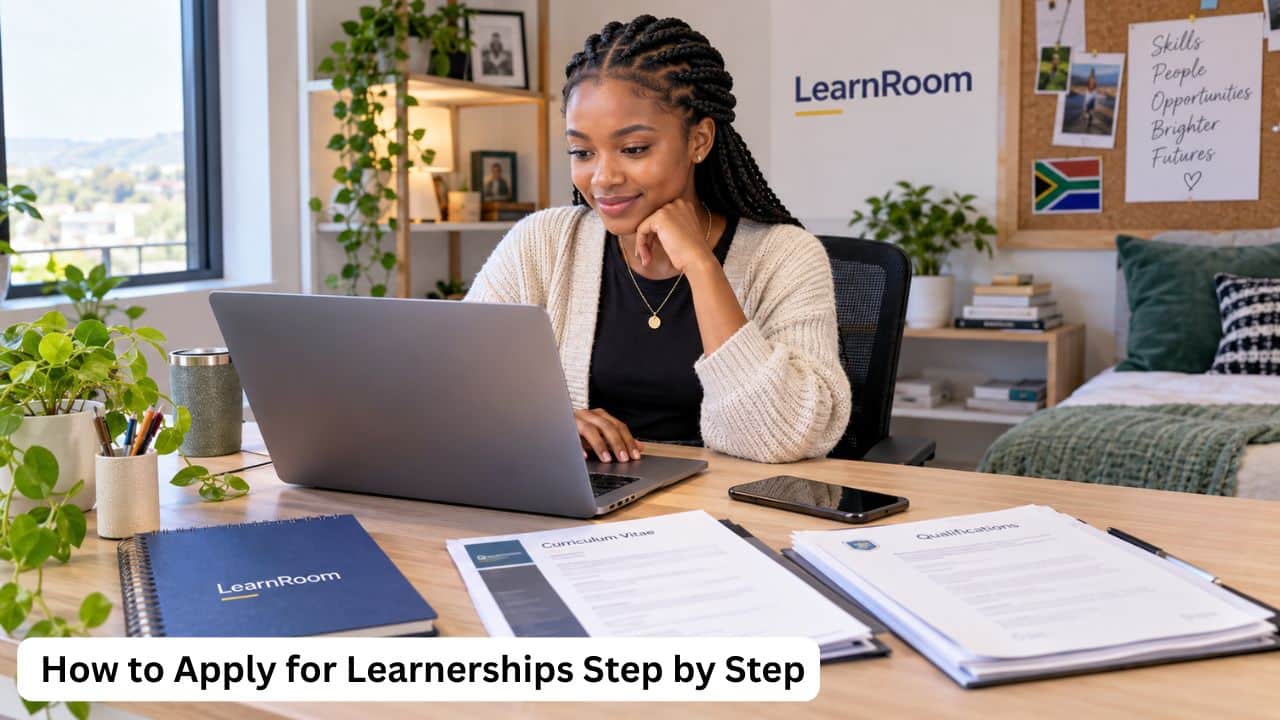
Applying for learnerships can feel complicated when different employers use different application systems and requirements. However, most strong applications follow the same basic process: find a legitimate opportunity, make sure you qualify, prepare the correct documents and follow the application instructions carefully.
There is no single application website or form used for every learnership. Some organisations accept applications through their own career portals, while others use recruitment platforms, email applications or dedicated programme forms.
Understanding the process before you start can help you avoid unnecessary mistakes and focus your time on opportunities that genuinely match your qualifications.
Step 1: Understand what you are applying for
Before sending applications, make sure you understand what a learnership is and how it works.
A learnership is not simply a temporary position. It combines structured learning with practical workplace experience and normally requires participants to complete training, workplace activities and assessments.
This means you need to be prepared to participate in both parts of the programme.
Knowing this from the beginning can also help you decide whether the programme fits your career goals and whether you can commit to its full duration.
Step 2: Find legitimate learnership opportunities
The next step is finding genuine programmes that are accepting applications.
Learnerships may be offered by:
- Private companies
- Government departments and public entities
- Sector Education and Training Authorities
- Training providers
- Colleges and educational institutions
- Non-profit organisations working with accredited training partners
You may also discover opportunities through career websites and social media.
However, discovering a programme on social media does not automatically mean the information is reliable.
If you find a learnership through Facebook, WhatsApp, TikTok or another social platform, try to trace the opportunity back to the organisation responsible for the programme before submitting personal documents.
Step 3: Check whether you meet the requirements
Do not start filling in the application immediately.
Read the eligibility requirements first.
Different programmes can have completely different entry requirements.
A learnership may specify requirements relating to:
- Grade 10, Grade 11 or Grade 12
- Particular school subjects
- A specific National Qualifications Framework level
- A diploma or other qualification
- Age
- Employment status
- Location
- Previous training
- South African citizenship or other programme-specific conditions
There is no universal qualification requirement that applies to every learnership.
For example, one programme may accept applicants with Grade 11, while another may require Grade 12 with Mathematics.
Applying without meeting an essential requirement usually reduces your chances of progressing through the selection process.
Step 4: Read the entire programme information
Do not rely only on the headline.
Read the complete programme information before applying.
Check the:
- Programme name
- Qualification requirements
- Required subjects
- Age requirements, where applicable
- Workplace or training location
- Programme duration
- Closing date
- Application method
- Required documents
- Allowance information, if provided
- Special conditions
Pay particular attention to whether applicants need to live in a particular area.
Some learnerships require participants to attend training or workplace activities in person, which can make location an important eligibility factor.
Step 5: Prepare the required documents
Once you have confirmed that you meet the requirements, start preparing your documents.
A programme may request documents such as:
- Curriculum vitae
- South African identity document
- Grade 12 certificate or school results
- Academic transcript
- Qualification certificates
- Proof of residence
- Other programme-specific supporting documents
Only submit documents that are requested.
Do not send unnecessary personal information simply because you think it might strengthen your application.
Your documents should also be clear and readable.
If you photograph or scan documents, check them before uploading. Blurry, cropped or unreadable documents can make it difficult for recruiters to assess your application.
Step 6: Prepare a clear curriculum vitae
You do not need years of employment experience to create a useful curriculum vitae for a learnership.
For an entry-level application, concentrate on information that helps the organisation understand your education, skills and potential.
A simple curriculum vitae can include:
- Full name
- Contact details
- Education
- Relevant school subjects
- Qualifications and certificates
- Skills
- Computer knowledge
- Languages
- Volunteer experience
- Short-term or informal experience that is relevant
Keep the document easy to read.
Avoid adding unnecessary information just to make the curriculum vitae longer.
If you have no formal work experience, focus on your education, abilities and activities that demonstrate responsibility or useful skills.
Step 7: Use professional contact details
Before applying, check the phone number and email address you plan to use.
Your email address should be simple and professional.
For example:
is generally easier for a recruiter to identify than an address containing random nicknames or complicated characters.
You should also use a phone number that you can access regularly.
If you change your contact details while applications are still active, you could miss communication from recruiters.
Step 8: Follow the application method exactly
This is one of the most important parts of the process.
If the organisation says applications must be submitted through an online application portal, use that portal.
If applications must be emailed, use the specified email address.
If the employer requests a particular email subject line, use it.
Do not send your curriculum vitae to unrelated company email addresses and assume someone will forward it to recruitment.
Following the stated application method helps make sure your documents reach the correct system or recruitment team.
Step 9: Complete online application forms carefully
Many organisations require applicants to complete an online form in addition to uploading a curriculum vitae.
You may need to enter information such as:
- Full name
- Identity number
- Contact information
- Education
- Qualifications
- Location
- Employment status
Enter this information carefully.
Check that your details match the documents you upload.
A simple mistake in your phone number or email address could make it difficult for the organisation to contact you.
If the system allows you to create an account, keep your login details secure because you may need them later to check the progress of your application.
Step 10: Name your files clearly
Before uploading documents, give them sensible file names.
For example:
Sabrah-Phaswana-CV.pdf
Sabrah-Phaswana-ID.pdf
Sabrah-Phaswana-Grade-12-Certificate.pdf
Clear file names make documents easier to identify than names such as:
IMG0024.jpg
or:
document-final-new2.pdf
Always follow specific file-naming instructions if the employer provides them.
Step 11: Review everything before submitting
Do not press submit immediately after attaching your documents.
Take a few minutes to review the application.
Check that:
- You meet the main requirements
- Your name is entered correctly
- Your phone number is correct
- Your email address is correct
- Your curriculum vitae is current
- All required documents are attached
- Your files are readable
- You selected the correct programme
- You followed any special instructions
- The closing date has not passed
This final check can prevent simple mistakes that are difficult to correct afterward.
Step 12: Submit before the closing date
Try not to wait until the final few minutes before a deadline.
Application websites can become slow, internet connections can fail and documents can take longer than expected to upload.
Submitting earlier gives you time to deal with technical problems.
It can also prevent situations where an application closes at a specific time rather than at midnight.
Always use the closing date published by the organisation responsible for the programme.
Step 13: Save proof of your application
After submitting, keep whatever confirmation the system provides.
This could be:
- A confirmation email
- Application reference number
- Confirmation page
- Screenshot showing successful submission
It is also helpful to keep your own record of applications.
You can write down:
Organisation:
Programme:
Date applied:
Closing date:
Application reference:
Status:
This becomes extremely useful once you start applying for several programmes.
Step 14: Check your email and phone
After applying, regularly check the contact details you provided.
Look at your email inbox as well as your spam or junk folder.
Some recruitment messages can accidentally be filtered.
If you are actively applying for opportunities, answering unfamiliar phone numbers professionally can also be useful because recruiters may contact you from numbers you do not recognise.
However, remain cautious about anyone asking for passwords, personal identification numbers or payments.
Step 15: Prepare for assessments
Some organisations require shortlisted applicants to complete assessments.
These may test areas such as:
- Numeracy
- Language ability
- Logical reasoning
- Computer literacy
- Technical knowledge
- Situational judgement
The assessment depends on the programme.
Do not assume every learnership uses the same selection process.
If you are invited to complete an assessment, carefully follow the instructions and make sure you understand any deadline attached to it.
Step 16: Prepare for a learnership interview
Some applicants may also be invited to an interview.
Before the interview, read the programme information again.
You should understand:
- What the organisation does
- What the learnership involves
- Why the programme interests you
- What skills you want to develop
- Why you believe you can complete the programme
You do not need to invent experience you do not have.
If the programme is aimed at entry-level candidates, recruiters already understand that applicants may have limited employment experience.
Focus on your willingness to learn, reliability, education and genuine interest in the opportunity.
Can you apply for more than one learnership?
Yes, you can pursue several opportunities that match your circumstances.
You do not need to rely on one application and wait indefinitely for a response.
However, applying widely should not mean applying carelessly.
A better strategy is to identify programmes where you genuinely meet the requirements and prepare each application properly.
Applying for 10 suitable programmes can be more productive than sending 100 applications for programmes you do not qualify for.
Should you use the same curriculum vitae every time?
Your basic curriculum vitae can remain the same, but you should review it before each application.
Different learnerships can value different skills.
For example, an information technology programme may benefit from highlighting computer-related skills, while a retail programme may place more emphasis on communication and customer service.
You should never change facts or invent experience.
The goal is simply to make sure the most relevant information is easy for the recruiter to see.
What happens after you submit your application?
There is no standard waiting period.
Some organisations begin shortlisting soon after applications close, while others may take much longer.
The process can include:
- Initial application screening
- Document verification
- Assessments
- Interviews
- Background or qualification checks
- Final selection
Some organisations contact only shortlisted candidates.
Because of this, you should continue searching for other suitable opportunities while waiting.
Do not stop applying simply because one programme looks promising.
What if you never receive a response?
Not receiving a response does not always mean there was something wrong with your application.
Some programmes receive large numbers of applications and communicate only with shortlisted candidates.
Continue improving your applications and looking for opportunities that match your qualifications.
Keeping a record of what you applied for can also help you identify patterns.
For example, if you repeatedly apply for programmes requiring qualifications you do not have, your strategy may need to change.
Do you have to pay to apply for a learnership?
You should be extremely cautious if someone asks you to pay money simply to submit an application or guarantees selection in exchange for payment.
Scammers can use genuine company names, logos and programme information to make fake opportunities appear convincing.
Before providing documents, try to verify:
- Who is offering the programme
- Whether the application website is legitimate
- Whether the email address belongs to the organisation
- Whether the programme appears on an official or trusted source
- Whether anyone is demanding payment for placement
A professional-looking poster does not automatically prove that an opportunity is genuine.
Never pay someone to guarantee selection
No individual can legitimately guarantee that you will be selected simply because you paid them.
Recruitment normally involves eligibility checks and a selection process.
Be suspicious of messages claiming things such as:
“Pay this fee and your place will be confirmed.”
or:
“Send money before we release your acceptance letter.”
Do not allow urgency to pressure you into sending money or sensitive information.
What if you have no work experience?
Many people applying for learnerships are entering the workplace for the first time.
Lack of formal employment should not automatically stop you from applying where previous experience is not required.
Instead, highlight what you already have.
That might include:
- Education
- School achievements
- Computer skills
- Communication ability
- Volunteering
- Community involvement
- Leadership activities
- Short courses
- Practical projects
Your application should accurately show what you can offer without pretending that you have experience you do not have.
What if your applications keep getting rejected?
Repeated rejection can be frustrating, but it can also be useful to review your application strategy.
Start with the basics.
Are you applying for programmes where you meet the requirements?
Is your curriculum vitae easy to read?
Are your supporting documents clear?
Are your contact details correct?
Are you following the application instructions?
Also remember that some programmes attract far more qualifying applicants than available places.
Not being selected does not necessarily mean your application was poorly prepared.
Continue searching while improving the parts of the process that you can control.
Build a simple application routine
Applying for learnerships becomes easier when you have a system.
You could keep one folder containing:
- Your latest curriculum vitae
- Identity document copy
- Qualifications
- School results
- Academic records
- Proof of residence where needed
- Certificates
You can then create another folder for submitted applications.
This helps you stay organised and reduces the chance of sending the wrong document.
Keeping an application tracker can also help you remember deadlines and follow the progress of different opportunities.
Final Thoughts
Learning how to apply for learnerships is not about finding a secret method that guarantees acceptance.
The strongest approach is much simpler.
Find legitimate opportunities, check that you qualify, prepare clear documents, follow the instructions carefully and submit before the deadline.
After applying, keep proof of your submission, monitor your phone and email and continue looking for other suitable programmes.
A carefully prepared application cannot guarantee selection, but it can make sure avoidable mistakes do not stand between you and an opportunity.
If you are still unfamiliar with how these programmes work, start with LearnRoom’s guide explaining what a learnership is, who can qualify and what learners can expect.
Frequently Asked Questions
Learnership opportunities can be published by companies, government organisations, training providers, educational institutions and Sector Education and Training Authorities. Always try to verify the programme through the organisation responsible for it before submitting personal information.
Yes. Many learnerships are designed for people entering the workplace for the first time. However, individual programmes can still have education, age, location or other eligibility requirements.
Requirements differ, but applicants may be asked for a curriculum vitae, identity document, school results, qualifications, academic records or proof of residence. Submit the documents requested by the individual programme.
Yes. You can pursue several suitable programmes. Keep a record of your applications so you know which organisation is contacting you.
There is no standard recruitment timeline. Some organisations contact candidates quickly, while others take several weeks or longer. Continue applying for other suitable opportunities while waiting.
Be very cautious about anyone asking for money in exchange for guaranteed acceptance or placement. Verify opportunities and application channels before providing money or sensitive personal information.
